
Watauga County Court Records After Arrest
A Watauga County arrest can create several records at different offices. The Watauga County Detention Center handles the custody side. The magistrate or judicial official handles release conditions. The District Attorney's Office for Prosecutorial District 35 reviews and prosecutes state criminal charges. The court record is the case file that tracks the filed charge, court dates, hearings, disposition, and financial obligations where public access is allowed.
The distinction matters because Watauga County does not publish a public online jail roster. Custody questions should go to the jail, while the charge history after arrest should be checked through North Carolina eCourts, Watauga courthouse resources, or the clerk's public terminal. For custody and booking context, use Watauga County jail inmate records. For booking photos, use the Watauga County jail mugshots page.
Arrest to Watauga Court Record
The arrest-to-court path starts with booking if the person is held locally. A magistrate or other judicial official sets release conditions under North Carolina pretrial law. The criminal case then appears under a case number, citation, warrant, or other process number, depending on the charge. The prosecutor can proceed, dismiss, amend, reduce, or seek indictment as the case develops. District court handles many misdemeanors and first appearances; superior court handles felonies after indictment or information and other matters.
- Arrest and booking occur through law enforcement and the Watauga County Detention Center when local custody is used.
- A judicial official sets pretrial release conditions, which may include a written promise, unsecured bond, secured bond, custody release, or house arrest with electronic monitoring.
- A court case is created or updated in the North Carolina Judicial Branch system.
- The District Attorney reviews the charge and decides how to proceed in court.
- The case record shows hearings, charge status, disposition, and other public case events where available.
This flow is why a jail arrest record and a court record may not match word for word. The arrest label is an intake snapshot. The filed charge is part of the court case.
Search Watauga County Court Records
The North Carolina Judicial Branch Watauga County page links court resources for the county, and the statewide eCourts Portal provides public search access for case records, hearing dates, documents where available, and payments. Watauga is listed in the Judicial Branch county materials as an eCourts county, so the portal is the main online starting point for court records after a jail arrest.
| Search Field | Type | Use | Notes |
|---|---|---|---|
| Name / Smart Search | Text | Defendant search | Use full name when possible to reduce false matches. |
| Case Number | Text | Known case lookup | Best when a citation, warrant, or case number is known. |
| Citation Number | Text | Traffic or citation cases | The Watauga county page notes citation-number searching. |
| County | Filter | Limit to Watauga | Prevents statewide name collisions. |
| Hearing Date | Date or filter | Find court dates | Useful after a recent arrest when a first appearance is pending. |
| Case Status | Filter | Active or closed cases | Portal options may vary by case and permission level. |
The eCourts Portal search screen is shown below as the statewide interface used for Watauga County court records after an arrest.
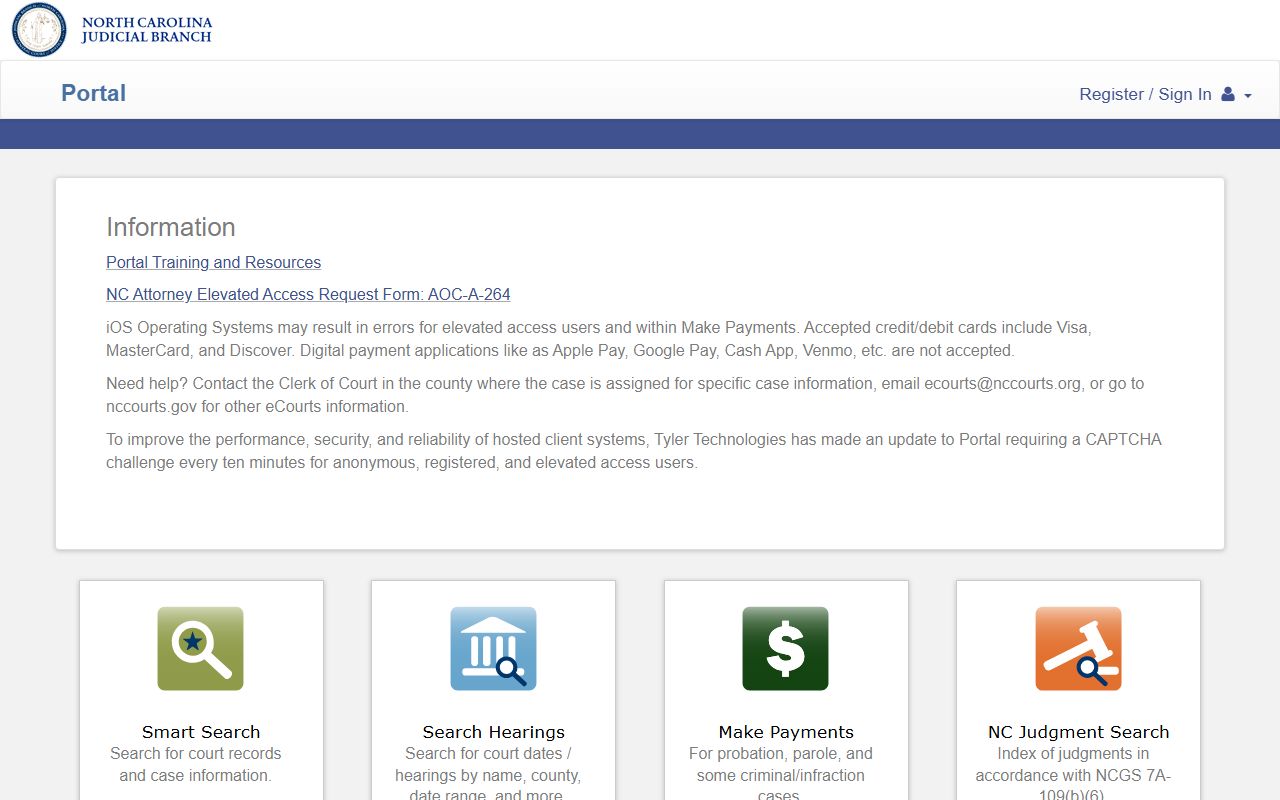
The portal is for court records, not a live jail list. If the goal is to learn whether a person is still in custody, call the detention center first.
Watauga Courthouse Record Access
The Watauga County Courthouse is at 842 W King Street, Suite 13, Boone. The main courthouse phone is (828) 268-6600. Hours are Monday through Friday, 8:00 a.m. to 5:00 p.m. The courthouse page says parking is behind the courthouse and on Queen Street in courthouse-marked metered areas. It also says the building is handicap accessible through the back entrance from the parking lot, visitors enter through security, and cell phones are not allowed in courtrooms.
The Judicial Branch court-record access guidance says criminal case information can be searched from public self-service terminals by defendant name, case number, or victim/witness name. Paper files are accessed at the clerk's office in the county where the case is located, and copies may require fees set by court policy.
Watauga County Courthouse
842 W King Street, Suite 13
Boone, NC 28607
(828) 268-6600
Monday to Friday, 8:00 a.m. to 5:00 p.m.
District Attorney After Arrest
Watauga County is in Prosecutorial District 35. The NC Conference of District Attorneys profile identifies Seth Banks as district attorney for Avery, Madison, Mitchell, Watauga, and Yancey counties. The Watauga court contact directory lists the District Attorney phone number as (828) 268-6610. The prosecutor's role is central to court records after a jail arrest because the prosecutor decides what filed charges move forward.
| Document | Who Uses It | What It Does |
|---|---|---|
| Complaint or warrant process | Officer, magistrate, or prosecutor | Starts or supports a criminal charge at the early court stage. |
| Information | Prosecutor | Formal charging document used in some felony or negotiated cases. |
| Indictment | Grand jury | Formal felony charge returned for superior court prosecution. |
Charge Status After Watauga Arrest
Court records after an arrest can change many times. A pending case is not a conviction. A prosecutor may amend a charge, reduce it, add related charges, dismiss one count while another remains, or seek an indictment that supersedes the earlier process. Always read the current status and disposition for each charge instead of relying on an arrest label.
| Status | What It Means |
|---|---|
| Pending | The charge remains open and has not reached final disposition. |
| Amended | The charge wording, level, or related count changed in court. |
| Reduced | The case moved to a lesser charge or lesser offense level. |
| Dismissed | The charge was dropped by the court or prosecutor. |
| Guilty or responsible | A plea, verdict, or finding produced a conviction or responsibility result. |
| Not guilty | The charge did not result in a conviction after trial or hearing. |
Bond and Release Records
North Carolina release conditions are governed by N.C. Gen. Stat. 15A-534. A judicial official may use a written promise to appear, unsecured appearance bond, custody release to a designated person or organization, secured appearance bond, or house arrest with electronic monitoring. A separate hold, warrant, probation issue, federal detainer, or ICE matter can keep someone in jail even when one local charge has a bond.
| Release Condition | Plain Meaning |
|---|---|
| Written promise | The person signs a promise to appear in court. |
| Unsecured bond | No money is paid up front, but a money amount can become due after failure to appear. |
| Secured bond | Cash, property, or surety bond is required before release. |
| Custody release | The person is released to an approved person or organization. |
| No-bond or hold | Release is blocked until a judge or another agency resolves the issue. |
Warrants and Orders for Arrest
No official Watauga County active-warrant search was located on the sheriff website. Public warrant questions should be routed through the Sheriff's Office non-emergency number, the Watauga magistrates at (828) 268-6619, the Clerk of Superior Court at (828) 268-6600, or the eCourts and public-terminal record tools. An order for arrest, bench warrant, fugitive hold, probation violation, or other process can create a jail booking and then appear in the court record.
Record boundary: A search warrant is not the same as an arrest warrant, and investigative records may be restricted while a case is active.
Charges vs Convictions
A charge is an accusation filed in court. A conviction is a final result after a guilty plea, verdict, or other qualifying finding. Watauga County court records after a jail arrest should be read with that difference in mind. Case status, disposition, and sentence fields matter more than the fact that an arrest occurred.
| Charge | Conviction | |
|---|---|---|
| Stage | Accusation or filed count | Final guilt-based result |
| Proof | Based on probable cause or charging process | Based on plea, verdict, or finding |
| Can Change | May be amended, reduced, or dismissed | May be appealed or later expunged if eligible |
Sealed and Expunged Arrest Records
North Carolina law provides expunction routes for some dismissed charges, findings of not guilty, and certain nonviolent convictions. N.C. Gen. Stat. 15A-146 covers expunction after dismissal or not guilty outcomes. N.C. Gen. Stat. 15A-145.5 covers certain nonviolent misdemeanor and felony convictions. Eligibility is case-specific.
| Sealed or Restricted | Expunged | |
|---|---|---|
| Public view | Hidden or limited by court rule or statute | Removed from ordinary public access after court order |
| Reason | Juvenile, confidential, sensitive, or court-limited matter | Dismissal, not guilty, or eligible conviction relief |
| How to check | Ask the clerk or court for access rules | Review the expunction order and court record status |
Restricted Watauga Court Records
North Carolina public records law is broad, but it has important limits. N.C. Gen. Stat. 132-1.4 restricts criminal investigation and intelligence records, while court rules and statutes can limit access to juvenile, sealed, confidential, or expunged material. Police reports, prisoner records, county records, and court records also have different custodians.
Important: Do not use casual court or jail searches for employment, tenant, credit, insurance, or other FCRA-covered screening.